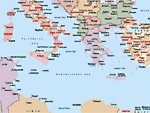
On Monday we enjoyed another lazy day at sea, our last before reaching Florence, the most populace city in Tuscany. During the trip north Captain D'Aita sailed past the island of Stromboli in the Tyrrhenian Sea, off the north coast of Sicily. The active volcano on the island has been erupting for over two thousand years and as we sail past it the smokes plumes are very evident. Can you imagine living at the base of the beast? Hundreds of folks do and apparently are unfazed by their proximity to potential danger.
The next morning we reached Livorno, the port city of Florence. Located on the Arno River, Florence is truly a renaissance city. The day we arrived it was raining, the first day of inclement weather we had experienced. We joined our friends and took the train from the port to the centre of the city. The best-known site and crowning architectural jewel of Florence is the domed cathedral of the city, Santa Marie del Fiore, known as The Duomo. The magnificent dome was built by Brunelleschi. We marveled at the beauty of the cathedral and its magnificent dome; The dome, 600 years after its completion, is still the largest dome built in brick and mortar in the world.

Our next stop was a quick walk down the Ponte Vecchio Bridge over the river. Along the bridge are dozen of shops filled with expensive and glittering gold necklaces, rings and chains. This is not to place for bargain shopping, but fun to window shop. A few blocks away lies the Uffizi Museum, our destination. I had made reservations online before we left home to avoid what can be a several hour wait. Our reservations were for one o'clock and we arrived a few minutes early. The museum is located adjacent to the Piazza della Signoria. The plaza displays a wonderful collection of statuary include one that bears a striking resemblance to me (see photo). I wondered whether or not I was the model for Michelangelo's David, in my past life...well, who knows.

Our next stop was a quick walk down the Ponte Vecchio Bridge over the river. Along the bridge are dozen of shops filled with expensive and glittering gold necklaces, rings and chains. This is not to place for bargain shopping, but fun to window shop. A few blocks away lies the Uffizi Museum, our destination. I had made reservations online before we left home to avoid what can be a several hour wait. Our reservations were for one o'clock and we arrived a few minutes early. The museum is located adjacent to the Piazza della Signoria. The plaza displays a wonderful collection of statuary include one that bears a striking resemblance to me (see photo). I wondered whether or not I was the model for Michelangelo's David, in my past life...well, who knows.
Open to the public since 1765, the Uffizi Gallery is one of the oldest and most famous art museums in the world and we were looking forward to seeing its treasures. As we walked through the various rooms of the gallery we gazed at the art work of Botticelli; da Vinci (The Annunciation); Durer; Michelangelo; Raphael; Titian and Caravaggio's Bacchus. Of course, the gallery houses thousands of other masterpieces from artists that for me were unrecognizable, but no less impressive. It was a educational and awe-inspiring visit. Later that afternoon we took the train back to the port of Livorno, where Freedom awaited to take us back to the beginning: Rome and an overnight stay.
We arrived at the port of Civitavecchia, which is about an hour train ride to Rome early in the morning. We met our new friends, the Rowlands, early in the morning and join ed them for the train ride to the city. Our destination today was to be the Borghese Park and the Borghese Gallery. We took the metro to the Spanish Steps and walked a couple of miles through the park until we reached the Villa Borghese Pinciana, originally the home of Cardinal Scipione Borghese. This impressive collection of sculptures includes the beautiful Apollo and Daphne and David completed in the 1600's by Bernini. Each room in the gallery has a centerpiece of magnificent works of art. The visit to the Borghese Gallery was well worth the time and is a place that few American tourists visit.
 ed them for the train ride to the city. Our destination today was to be the Borghese Park and the Borghese Gallery. We took the metro to the Spanish Steps and walked a couple of miles through the park until we reached the Villa Borghese Pinciana, originally the home of Cardinal Scipione Borghese. This impressive collection of sculptures includes the beautiful Apollo and Daphne and David completed in the 1600's by Bernini. Each room in the gallery has a centerpiece of magnificent works of art. The visit to the Borghese Gallery was well worth the time and is a place that few American tourists visit.
 Our next stop were places where every Ame rican visiting Rome stops and of course, photographs. The 138 Spanish Steps began at the Piazza de Spagna and end at the Trinita dei Monti, an impressive church built by the Bourbons of France. The Steps are always occupied by students eating lunch (forbidden!) and smoking cigarettes (still a very popular habit in Europe). After leaving the Steps we walked the several blocks to our final stop, the Trevi Fountain. One of the largest of the Baroque fountains in Rome, its central appeal is the magnificent sculpture surrounding the fountain. Taming of the waters is the theme of the gigantic scheme that tumbles forward, mixing water and rockwork, and filling the small square. Tritons guide Oceanus' shell chariot, taming seahorses. In the center is superimposed a robustly modelled arch. In the center are free-standing columns for maximal light-and-shade. In the niches flanking O
 ceanus, Abundance spills water from her urn and Salubrity holds a cup from which a snake drinks. the bas reliefs illustrate the Roman origin of the aqueducts. Shirley tossed the obligatory coin into the fountain signifying that she will once again return to Rome. If you cannot make it to the Trevi Fountain in Rome there is a scaled-down replica of the Trevi Fountain at Caesars Palace in Las Vegas. As for us, it was back to Freedom and our last evening in cabin 8249.
 rican visiting Rome stops and of course, photographs. The 138 Spanish Steps began at the Piazza de Spagna and end at the Trinita dei Monti, an impressive church built by the Bourbons of France. The Steps are always occupied by students eating lunch (forbidden!) and smoking cigarettes (still a very popular habit in Europe). After leaving the Steps we walked the several blocks to our final stop, the Trevi Fountain. One of the largest of the Baroque fountains in Rome, its central appeal is the magnificent sculpture surrounding the fountain. Taming of the waters is the theme of the gigantic scheme that tumbles forward, mixing water and rockwork, and filling the small square. Tritons guide Oceanus' shell chariot, taming seahorses. In the center is superimposed a robustly modelled arch. In the center are free-standing columns for maximal light-and-shade. In the niches flanking O
 ceanus, Abundance spills water from her urn and Salubrity holds a cup from which a snake drinks. the bas reliefs illustrate the Roman origin of the aqueducts. Shirley tossed the obligatory coin into the fountain signifying that she will once again return to Rome. If you cannot make it to the Trevi Fountain in Rome there is a scaled-down replica of the Trevi Fountain at Caesars Palace in Las Vegas. As for us, it was back to Freedom and our last evening in cabin 8249.
We were aware that this was to be our last night aboard ship and that our journey had taken us to places far and wide that we had only imagined visiting. We passed on the dining room after a very long day and grabbed a quick bite at the Lido buffet and made a quick pass through the shops and venues on board before retiring for the night. Tomorrow we would once again board the train to Rome for our eventual trip to Fumicino Airport. It has been an exhausting and yet, exhilerating trip. Our plane that evening takes us to Paris, the City of Lights, but unfortunately our stay in just overnight and so we will not have time to visit the grand city.....at least not this time. Our heads are full of memories of both exciting and frustrating moments during our twelve day trip through the Eastern Mediterreanean. It was a good trip.